How to Cite
Abstract
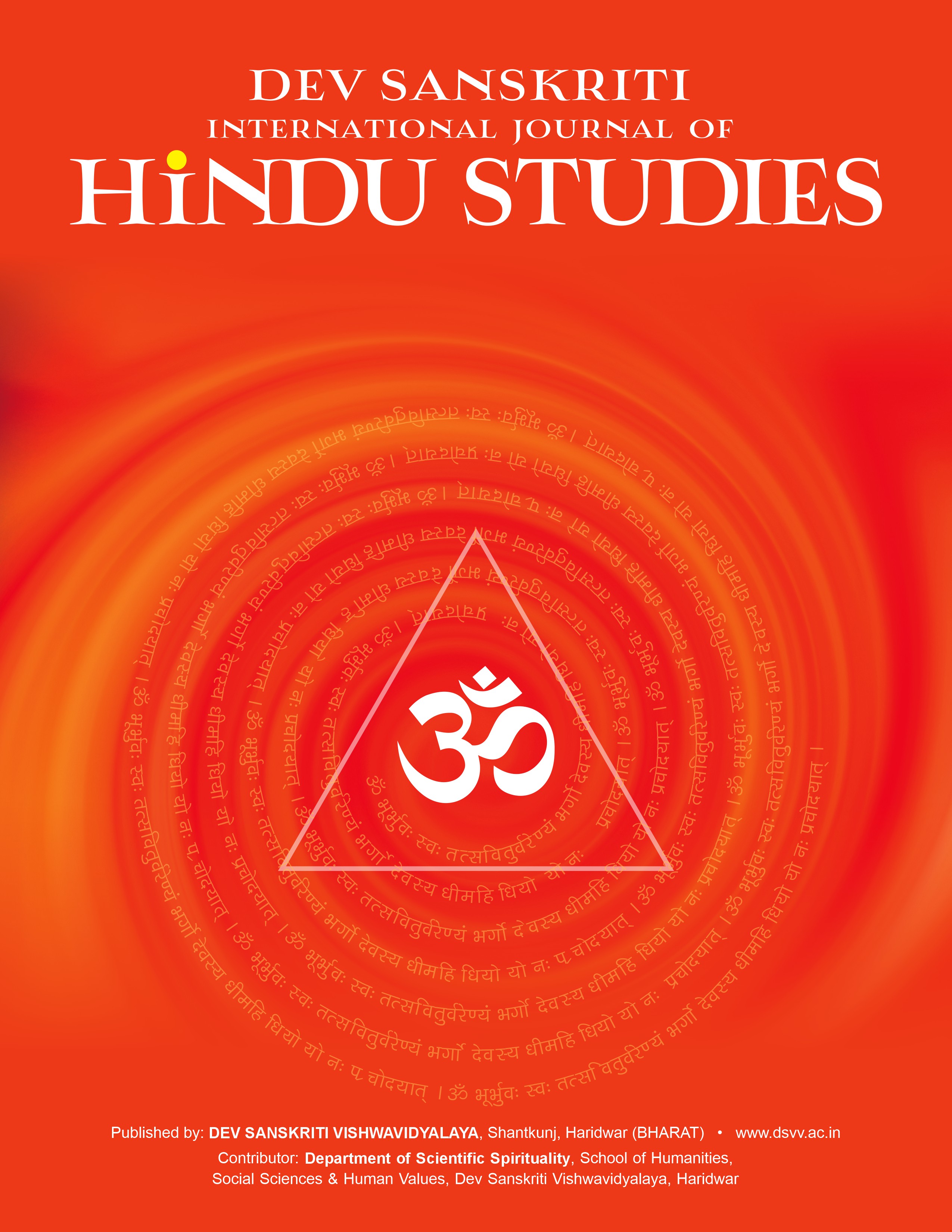
Dev Sanskriti Vishwavidyalaya proudly presents the inaugural issue of the Dev Sanskriti International Journal of Hindu Studies (DSIJHS), Volume 1, Issue 1, for the year 2025. As the third research journal contributing to open-access, high-quality studies in the domain of Dev Sanskriti and Indian culture, this journal embarks on a journey to explore the profound dimensions of Hindu thought, philosophy, and civilization. This marks a significant milestone in scholarly research, focusing on Sanatan Sanskriti, also known as Dev Sanskriti, which has manifested over millennia as Hindu culture. The journal aims to provide an academic platform for scholars, researchers, and practitioners who are deeply engaged in the study of Indian traditions, scriptures, and practices.
The articles in this issue reflect the diversity and depth of Hindu studies, offering insights into historical narratives, spiritual traditions, and socio-cultural practices. The first article, "Analyzing Gender Dynamics in Indian Itihāsa Texts Beyond Popular Narratives," by Astha Tiwari, Anurag Tripathi, and Rajesh Ranjan, reassesses gender roles in Hindu traditions. Through a thorough analysis of various Itihāsa texts, the authors reveal the fluidity of gender roles in ancient Bharata, demonstrating that both men and women played dynamic roles in shaping society. The study presents examples such as Sāvitrī’s determination and Ruru’s selfless love, showcasing a broader gender narrative beyond mainstream discourse.
The second article, "Sanatan Dharma: The Eternal Path of Righteousness and Human Evolution," by Vivek Vijay, explores the philosophical foundation of Sanatan Dharma. Referencing the Bhagavad Gita, Upanishads, and Vedas, it highlights the concept of Dharma’s adaptability and relevance in contemporary ethical living. Drawing insights from Swami Vivekananda, Sri Aurobindo, and Pandit Shriram Sharma Acharya, the article underscores how Sanatan Dharma transcends sectarian boundaries, guiding both individual and societal harmony.
Another insightful contribution, "The Age-Old Tradition of Maa Narmada Parikrama: A Spiritual and Geographical Perspective" by Ekta Chandel, examines the spiritual, historical, and ecological dimensions of the Narmada River and the sacred practice of Narmada Parikrama. Referencing the Mahabharata and Markandeya Purana, the article highlights the sanctity of the river and its impact on devotees. It also emphasizes the need for conservation efforts to sustain the ecological balance of this revered water body, merging faith with environmental awareness.
The fourth article, चन्द्रमा ध्यान का चिंता पर संभावित प्रभाव- एक विवेचनात्मक अध्ययन, by Poonam and Swarnakala Singh, presents an in-depth study of Chandra Dhyana meditation as conceptualized by Dr. Pranav Pandya. The research explores its impact on mental well-being, particularly in alleviating anxiety and fostering inner tranquility. By connecting traditional yogic wisdom with modern psychology, the study offers valuable insights into the therapeutic benefits of lunar meditation for mental clarity.
Concluding this issue is आँवला नवमी (भारतीय संस्कृति का पर्व) का ज्ञान-विज्ञान - व्यक्तिगत एवं वैश्विक समस्याओं के समाधान की दृष्टि से, by Saurabh Mishra and Alka Mishra. This article revisits the Indian festival of Amla Navami, emphasizing its cultural, ecological, and health-related significance. The authors highlight the wisdom embedded in Indian festivals, illustrating how they promote environmental sustainability, communal harmony, and holistic well-being. The study advocates for a renewed understanding of such festivals as a means to address contemporary global challenges, including ecological degradation and societal discord.
With this first issue of DSIJHS, we aim to spark scholarly engagement in Hindu studies, bridging traditional wisdom with modern inquiry. The journal provides a platform for dialogue and discovery, inviting scholars to enrich the global discourse on Hindu thought and culture. We hope it serves as a beacon of knowledge, inspiring future generations to explore and uphold the rich heritage of Dev Sanskriti.
References

This work is licensed under a Creative Commons Attribution 4.0 International License.
Copyright (c) 2025 Editor (Author)